

FOXBORO FBM216 HART® Communication Redundant Input Interface Module
FBM216 HART® Communication Redundant Input Interface Module
The FBM216 offers redundant modules for eight input channels, each accepting a 4 to 20mA analog signal
or a digital HART® signal superimposed on a 4 to 20 mA analog signal.
FEATURES
Key features of the FBM216 module are:
Eight analog input channels, each accepting one
of the following inputs:
• Standard 4 to 20 mA analog sensor signal
• Digital HART Frequency Shift Keying (FSK)
signal superimposed on a 4 to 20 mA analog
signal.
Module pair offers redundancy at the FBM level
FSK modem dedicated to each input channel for
bi-directional digital communications with a
HART field device
Analog to digital conversion of each of the 4 to
20 mA input signal from the HART devices
Support for the HART universal commands
necessary to interface the field device with the
I/A Series® system database
Galvanic isolation of the group of 8 input
channels from ground and module logic
Compact, rugged design suitable for enclosure in
Class G3 (harsh) environments
High accuracy achieved by sigma-delta data
conversions for each channel
Termination Assemblies (TAs) for locally or
remotely connecting field wiring to the FBM216
Termination Assemblies for per channel internally
and/or externally loop powered transmitters.
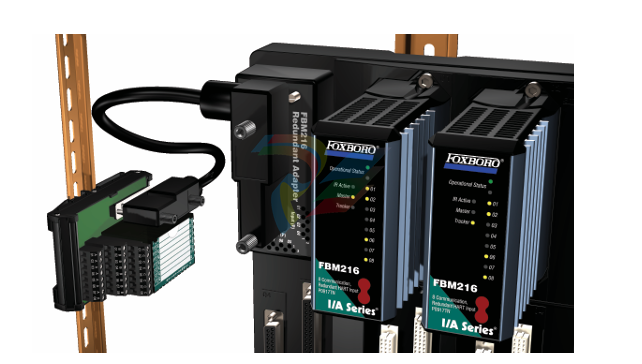
OVERVIEW
The FBM216 HART Communication Redundant
Input Interface Module contains eight group-isolated
input channels. The FBM216 supports any mix of
standard 4 to 20 mA devices and HART devices.
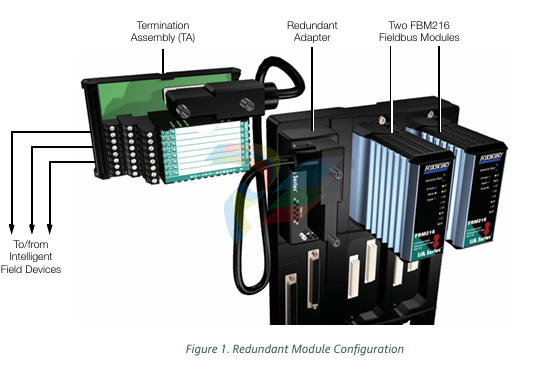
A pair of modules combines to provide redundancy
at the Fieldbus Module (FBM) level, with field inputs
wired to one common termination assembly (see
Figure 1). In this configuration, one FBM216 is the
Master, and the other is the Tracker.
The FBM216 serves as a HART communications field
device host, enabling the I/A Series system to
request and receive two digital messages per second
from each field device. The message pass-through
capability can be used to support HART universal,
common practice, and device-specific commands,
but not the burst communication mode. These
commands are implemented using the Intelligent
Field Device Configurator (IFDC — refer to PSS
21S-8A2 B3 for details).
The FBM216 provides a common isolated power
supply to power all eight channels. Optionally, the
channels can be powered by an external power
supply, in which case a Cable Balun module is
required to prevent channel crosstalk.
HIGH ACCURACY
For high accuracy, the module incorporates a Sigma
Delta converter which can provide new analog input
values for each channel every 100 milliseconds.
COMPACT DESIGN
The FBM216 has a compact design, with a rugged
extruded aluminum exterior for physical protection of
the circuits. Enclosures specially designed for
mounting the FBMs provide various levels of
environmental protection, up to harsh environments
per ISA Standard S71.04
HIGH RELIABILITY
The redundancy of the module pair, coupled with the
high coverage of faults, provides very high
subsystem availability time.
Either module may be replaced without upsetting
field input signals to the other module. A module can
be removed or replaced without removing field
device termination cabling, power, or
communications cabling.
REDUNDANT ANALOG INPUTS
For each input operation, identical reads are sent to
both modules, fully exercising the Fieldbus and the
logic circuitry of each module. Each input channel
accepts an analog sensor input or a self-powered
4 to 20 mA source. Device power from each module
is diode OR’d together in the redundant adapter to
ensure redundant power.
The microprocessor of each module executes the
analog I/O application program, plus security routines
that validate the health of the FBM. Input channel
security is enhanced by redundantly powering the
input current loop from per-channel power supplies in
each module of the pair.
VISUAL INDICATORS
Light-emitting diodes (LEDs) incorporated into the
front of the module provide visual indication of the
module’s operational and redundancy status, and
communication activity on the channels. Two
additional LEDs provide the master or tracker status
of the modules.
FIELDBUS COMMUNICATION
A Fieldbus Communication Module or a Control
Processor interfaces the redundant 2 Mbps module
Fieldbus used by the FBMs. The FBM216 module
accepts communication from either path (A or B) of
the redundant 2 Mbps fieldbus – should one path fail
or be switched at the system level, the module
continues communication over the active path.
The use of an external power supply common to two
or more loops requires a Cable Balun module to
maintain communication signal line balance.
MODULAR BASEPLATE MOUNTING
The module mounts on a modular baseplate which
accommodates up to four or eight FBMs. The
modular baseplate is either DIN rail mounted or rack
mounted, and includes signal connectors for
redundant fieldbus, redundant independent dc
power, and termination cables.
Redundant modules must be lo
CABLE BALUN MODULE
The Cable Balun module is used to maintain digital
communication line balance for HART Transmitter to
FBM loops that are powered from a common
external power supply. This powering effectively
connects one line of each loop together. Without the
Baluns, in each loop so powered, the common
connection at the external power supply, would
cause near end crosstalk at the system end of the
loop wiring cable. Loops using FBM internal power
source do not require Baluns.
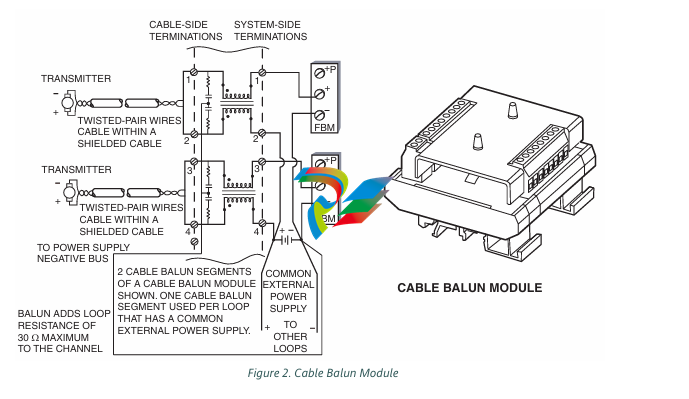
The Cable Balun module contains multiple Baluns.
One Balun segment is interconnected in each loop
powered from an external power supply per the
diagram above. There is one Cable Balun module.
Field Device Channels
VERSION SUPPORTED
HART Protocol v6
INTERFACE
8 group-isolated channels
COMMUNICATION TO THE DEVICE
Point-to-point, master/slave, asynchronous, half
duplex, at 1200 baud
ERROR CHECKING
Parity on each byte, and one CRC check byte
SPEED
2 messages per second
FASTEST ALLOWED ECB BLOCK PERIOD
500 msec
MAXIMUM DISTANCE (FBM216 TO FIELD
DEVICE)
Meets HART FSK physical layer specification
HCF_SPEC-54. Revision 8.1 [up to 3030 m
(10000 ft)](1)
COMPLIANCE VOLTAGE
18 V dc minimum at 20.5 mA
CURRENT INPUTS
Sense Resistor
61.9 Ω nominal
Total Input Resistance
280 Ω minimum
Analog Accuracy (Includes Nonlinearity)
± 0.075%(2) of full scale
Temperature Coefficient
50 PPM/°C
Resolution
15 bits
Update Rate
100 ms
Integration Time
500 ms
Common Mode Rejection
>100 db at 50 or 60 Hz
Normal Mode Rejection
>35 db at 50 or 60 Hz
LOOP POWER SUPPLY PROTECTION
Each channel is galvanically group isolated,
current limited, and voltage regulated.
All inputs are limited by their design to less than
30 mA with a single module installed (60 MA
when redundant modules are installed). If the
current limit circuit shorts out, the current is
limited to about 85 mA.
MAXIMUM LOOP RESISTANCE
280 Ω (not including the field device)(3)
FBM INPUT IMPEDANCE
280 Ω minimum
FBM INTERNAL POWER FOR FIELD DEVICE
24 V dc ±10% common power supply for all
channels. Loop load limited to one device per
channel.
ISOLATION
The channels are not galvanically isolated from
each other, but are galvanically isolated (both
optical and transformer isolation) as a group from
ground and module logic. Inputs use an internal
FBM isolated power supply for field power. The
module withstands, without damage, a potential
of 600 V ac applied for one minute between the
group isolated channels and earth (ground).
CAUTION
This does not imply that these channels are
intended for permanent connection to
voltages of these levels. Exceeding the limits
for input voltages, as stated elsewhere in this
specification, violates electrical safety codes
and may expose users to electric shock
FUNCTIONAL SPECIFICATIONS (CONTINUED)
Fieldbus Communication
Communicates with its associated FCM or FCP via
the redundant 2 Mbps module Fieldbus
Power Requirements
INPUT VOLTAGE RANGE (REDUNDANT)
24 V dc ±5%
CONSUMPTION
7 W (maximum)
HEAT DISSIPATION
4 W (maximum)
Regulatory Compliance
ELECTROMAGNETIC COMPATIBILITY (EMC)
European EMC Directive 89/336/EEC
Meets: EN 50081-2 Emission standard
EN 50082-2 Immunity standard
EN 61326 Annex A (Industrial Levels)
CISPR 11. Industrial Scientific and Medical
(ISM) Radio-frequency Equipment -
Electromagnetic Disturbance Characteristics - Limits and Methods of Measurement
Meets Class A Limits
IEC 61000-4-2 ESD Immunity
Contact 4 kV, air 8 kV
IEC 61000-4-3 Radiated Field Immunity
10 V/m at 80 to 1000 MHz
IEC 61000-4-4 Electrical Fast
Transient/Burst Immunity
2 kV on I/O, dc power and communication
lines
IEC 61000-4-5 Surge Immunity
2kV on ac and dc power lines; 1kV on I/O
and communications lines
IEC 61000-4-6 Immunity to Conducted
Disturbances
10 V (rms) at 150 kHz to 80 MHz on I/O,
dc power and communication lines
IEC 61000-4-8 Power Frequency Magnetic
Field Immunity
30 A/m at 50 and 60 Hz
PRODUCT SAFETY
European Low Voltage Directive 73/23/EEC
SAFETY CERTIFICATION (FBM AND CABLE
BALUN)
Underwriters Laboratories (UL) for U.S. and
Canada
UL/UL-C listed as suitable for use in
UL/UL-C listed Class I, Groups A-D;
Division 2; temperature code T4 enclosure
based systems. These modules are also UL
and UL-C listed as associated apparatus for
supplying non-incendive communication
circuits for Class I, Groups A-D hazardous
locations when connected to specified
I/A Series® processor modules as described
in the I/A Series DIN Rail Mounted
Subsystem User’s Guide (B0400FA). Where
power is supplied by the FBM,
communications circuits also meet the
requirements for Class 2 as defined in
Article 725 of the National Electrical Code
(NFPA No.70) and Section 16 of the
Canadian Electrical Code (CSA C22.1).
Conditions for use are as specified in the
I/A Series DIN Rail Mounted Subsystem
User’s Guide (B0400FA).
European Low Voltage Directive 73/23/EEC
and Explosive Atmospheres (ATEX) directive
94/9/EC
CENELEC (DEMKO) certified as EEx nA IIC
T4 for use in CENELEC certified Zone 2
enclosure certified as associated apparatus
for supplying non-incendive field circuits for
Zone 2. Group IIC, potentially explosive
atmospheres when connected to specified
I/A Series processor modules as described
in the I/A Series DIN Rail Mounted
Subsystem User’s Guide (B0400FA). Also,
see Table 1 on page 10.
Calibration Requirements
Calibration of the module or termination assembly is
not required
ENVIRONMENTAL SPECIFICATIONS(4)
Operating
TEMPERATURE
Module-20 to +70°C (-4 to +158°F)
Termination Assembly
PVC-20 to +50°C (-4 to +122°F)
PA-20 to +70°C (-4 to +158°F)
RELATIVE HUMIDITY
5 to 95% (noncondensing)
ALTITUDE-300 to +3.000 m (-1.000 to +10.000 ft)
Storage
TEMPERATURE-40 to +70°C (-40 to +158°F)
RELATIVE HUMIDITY
5 to 95% (noncondensing)
ALTITUDE-300 to +12.000 m (-1.000 to +40.000 ft)
Contamination
Suitable for use in Class G3 (Harsh) environments as
defined in ISA Standard S71.04. based on exposure
testing according to EIA Standard 364-65. Class III.
Vibration
7.5 m/S2 (0.75 g) from 5 to 500 Hz
PHYSICAL SPECIFICATIONS
Mounting
MODULE
FBM216 mounts on a modular baseplate. The
baseplate can be mounted on a DIN rail
(horizontally or vertically), or horizontally on a
19-inch rack using a mounting kit. Refer to
PSS 21H-2W6 B4 for details.
TERMINATION ASSEMBLY
The TA mounts on a DIN rail and accommodates
multiple DIN rail styles including 32 mm (1.26 in)
and 35 mm 1.38 in).
Mass
MODULE
284 g (10 oz) approximate
TERMINATION ASSEMBLY
Compression
181 g (0.40 lb) approximate
Ring Lug
249 g (0.55 lb) approximate
Dimensions – Module
HEIGHT
102 mm (4 in)
114 mm (4.5 in) including mounting lugs
WIDTH
45 mm (1.75 in)
DEPTH
104 mm (4.11 in)
Dimensions – Termination Assembly
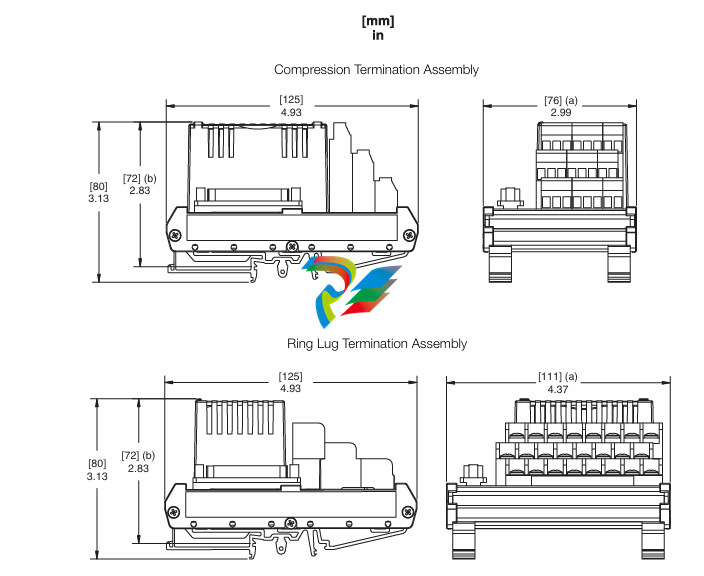
See page 11.
Part Numbers
FBM216 MODULE
P0922VV
TERMINATION ASSEMBLIES
See “FUNCTIONAL SPECIFICATIONS –
TERMINATION ASSEMBLIES” on page 9
REDUNDANT ADAPTER
P0917XQ
Termination Cables
CABLE LENGTHS
Up to 30 m (98 ft)
CABLE MATERIALS
Polyurethane or Hypalon®/XLP
TERMINATION CABLE TYPE
Types 1 – See Table 2 on page 10.
CABLE CONNECTION – TA
25-pin male D-subminiature
Construction – Termination Assembly
MATERIAL
Polyvinyl Chloride (PVC), compression
Polyamide (PA), compression
PVC, ring lug
FAMILY GROUP COLOR
Green – communication
TERMINAL BLOCKS
3 tiers, 8 positions
Field Termination Connections
COMPRESSION-TYPE ACCEPTED WIRING
SIZES
Solid/Stranded/AWG
0.2 to 4 mm2/0.2 to 2.5 mm2/24 to 12 AWG
Stranded with Ferrules
0.2 to 2.5 mm2 with or without plastic collar
RING-LUG TYPE ACCEPTED WIRING SIZES
#6 size connectors (0.375 in (9.5 mm))
0.5 to 4 mm2/22 AWG to 12 AWG
TERMINATION ASSEMBLIES AND CABLES
Field input signals connect to the FBM subsystem via
DIN rail mounted Termination Assemblies, which are
electrically passive. TAs for the FBM216 are
available in the following forms:
Compression screw type using Polyvinyl Chloride
(PVC) material
Compression screw type using Polyamide (PA)
material
Ring lug type using PVC material
See the following “FUNCTIONAL SPECIFICATIONS –
TERMINATION ASSEMBLIES” for a list of TAs used
with the FBM216.
The FBM216 provides sufficient loop resistance to
allow use of the HART Hand-Held Terminal, or PC20
Intelligent Field Device Configurator (PSS 2A-1Z3 E).
A removable termination cable connects the DIN rail
mounted TA to the FBM via a field connector on the
baseplate in which the FBM is installed. Termination
cables are available in the following materials:
Polyurethane
Hypalon XLP.
Termination cables are available in a variety of
lengths, up to 30 meters (98 feet), allowing the
Termination Assembly to be mounted in either the
enclosure or in an adjacent enclosure. See Table 2
for a list of termination cables used with the TAs for
the FBM216.
-
Beckhoff CX5620-0225 CPU module
-
Beckhoff CX5620-0220 CPU module
-
Beckhoff CX5620-0215 CPU module, Beckhoff RT Linux®
-
Beckhoff CX5620-0210 CPU module, Beckhoff RT Linux®
-
Beckhoff CX5620-0195 CPU module
-
Beckhoff CX5620-0190 CPU module
-
Beckhoff CX5620-0185 CPU module
-
Beckhoff CX5620-0175 CPU module
-
Beckhoff CX5620-0170 CPU module
-
Beckhoff CX5620-0163 CPU module
-
Beckhoff CX5620-0162 CPU module
-
Beckhoff CX5620-0161 CPU module
-
Beckhoff CX5620-0160 CPU module
-
Beckhoff CX5620-0100 CPU module
-
Beckhoff CX5120-0195 CPU module
-
Beckhoff CX5120-0190 CPU module
-
Beckhoff CX5120-0185 CPU module
-
Beckhoff CX5120-0175 CPU module
-
Beckhoff CX5120-0170 CPU module
-
Beckhoff CX5120-0163 CPU module
-
Beckhoff CX5120-0162 CPU module,
-
Beckhoff CX5120-0161 CPU module
-
Beckhoff CX5120-0160 CPU module,
-
Beckhoff CX5120-0150 CPU module
-
Beckhoff CX5120-0143 CPU module
-
Beckhoff CX5120-0142 CPU module
-
Beckhoff CX5120-0141 CPU module, Microsoft Windows 10 IoT Enterprise 2016 LTSB
-
Beckhoff CX5120-0140 CPU module
-
Beckhoff CX5120-0130 CPU module
-
Beckhoff CX5120-0123 CPU module
-
Beckhoff CX5120-0122 CPU module
-
Beckhoff CX5120-0120 CPU module
-
Beckhoff CX5120-0113 CPU module
-
Beckhoff CX5120-0112 CPU module
-
Beckhoff CX5120-0111 CPU module
-
Beckhoff CX5120-0110 CPU module
-
Beckhoff CX5120-0100 CPU module, no operating system
-
Beckhoff C6017-0040 | Fanless ultra-compact Industrial PC
-
Beckhoff C6017 | Fanless ultra-compact Industrial PC
-
Beckhoff C6015-0030 | Fanless ultra-compact Industrial PC
-
Beckhoff C6015-0040 | Fanless ultra-compact Industrial PC
-
Beckhoff C6015 | Fanless ultra-compact Industrial PC
-
Beckhoff CX2500-M510 | Fieldbus master module
-
Beckhoff CX2500-M310 | Fieldbus master module
-
Beckhoff CX2500-B510 | Fieldbus slave module
-
Beckhoff CX2500-B310 | Fieldbus slave module PROFIBUS for CX20xx, CX52x0. CX53x0. CX56x0
-
Beckhoff CX2500-0070 | USB 3.0 module for CX20xx, CX52xx, CX53x0. CX56x0
-
Beckhoff CX2500-0062 | 2.5 Gbit Ethernet module for CX20xx, CX52x0. CX53x0. CX56x0
-
Beckhoff CX2500-1061 | Power over Ethernet module for CX20xx, CX52x0. CX53x0. CX56x0
-
Beckhoff CX2500-1060 | Ethernet module for CX20xx, CX52x0. CX53x0. CX56x0
-
Beckhoff CX2500-0031 | Serial Interface RS485/RS422
-
Beckhoff CX2500-0030 | Serial Interface RS232 for CX20xx, CX52x0. CX53x0. CX56x0
-
Beckhoff CX5230-0195 CPU module
-
Beckhoff CX5230-0190 CPU module
-
Beckhoff CX5230-0175 CPU module,
-
Beckhoff CX5230-0170 CPU module
-
Beckhoff CX5230-0100 CPU module, no operating system, no TwinCAT
-
Beckhoff CU8130-0240 | UPS modul, battery-backed
-
Beckhoff CU8130-0120 | UPS module, battery-backed
-
Beckhoff CU8110-0120 | UPS module, capacitive
-
Beckhoff CU8110-0060 | UPS module, capacitive
-
Beckhoff CX5130-0195 CPU module
-
Beckhoff CX5130-0190 CPU module
-
Beckhoff CX5130-0185 CPU module
-
Beckhoff CX5130-0170 CPU module
-
Beckhoff CX5130-0163 CPU module, Microsoft Windows 10 IoT Enterprise 2019 LTSC, 32 bit
-
Beckhoff CX5130-0162 CPU module
-
Beckhoff CX5130-0161 CPU module
-
Beckhoff CX5130-0160 CPU module
-
Beckhoff CX5130-0155 CPU module
-
Beckhoff CX5130-0150 CPU module
-
Beckhoff CX5130-0143 CPU module
-
Beckhoff CX5130-0142 CPU module
-
Beckhoff CX5130-0140 CPU module
-
Beckhoff CX5130-0135 CPU module
-
Beckhoff CX5130-0130 CPU module
-
Beckhoff CX5130-0125 CPU module
-
Beckhoff CX5130-0123 CPU module
-
Beckhoff CX5130-0122 CPU module
-
Beckhoff CX5130-0121 CPU module
-
Beckhoff CX5130-0115 CPU module,
-
Beckhoff CX5130-0113 CPU module
-
Beckhoff CX5130-0112 CPU module
-
Beckhoff CX5130-0111 CPU module
-
Beckhoff CX5130-0110 CPU module, Microsoft Windows Embedded Compact 7. no TwinCAT
-
Beckhoff CX5130-0100 CPU module, no operating system, no TwinCAT
-
DEIF FAS-113DG Synchronisation & circuit breaker closing
-
DEIF FAS-115DG Synchronisation & circuit breaker closing
-
DEIF HAS-111DG Synchronisation & circuit breaker closing
-
DEIF LSU-122DG Load sharing, paralleling & operation
-
DEIF LSU-114DG Load sharing, paralleling & operation
-
DEIF LSU-113DG Load sharing, paralleling & operation
-
DEIF LSU-112DG Load sharing, paralleling & operation
-
DEIF RMF-112D Frequency relay
-
DEIF RMC-142D Current relay
-
DEIF RMC-132D Current relay
-
DEIF RMC-131D Current relay
-
DEIF RMC-122D Current relay
-
DEIF RMC-121D Current relay
-
DEIF RMC-111D Current relay
-
DEIF MVR-V211 Busbar Protection
-
DEIF MVR-T257 Transformer Differential Protection
-
DEIF MVR-T256 Transformer Differential Protection
-
DEIF MVR-T216 Transformer Differential Protection
-
DEIF MVR-T215 Transformer Protection
-
DEIF MVR-M257 Motor Differential Protection
-
DEIF MVR-M255 Motor Protection
-
DEIF MVR-M215 Motor Protection
-
DEIF MVR-M210 Motor Protection
-
DEIF MVR-G257 Generator Differential Protection
-
DEIF MVR-G215 Generator Protection
-
DEIF MVR-F255 Directional Feeder Protection
-
DEIF MVR-F215 Directional Feeder Protection
-
DEIF MVR-F210 Feeder Protection
-
DEIF MVR-F205 Directional Feeder Protection
-
DEIF MVR-F201 Basic Feeder Protection
-
DEIF MVR-200 series Medium Voltage Relay
-
DEIF MDR-2 Multi-differential relay
-
DEIF LMR-122D Loss of mains relay
-
DEIF LMR-111D Loss of mains relay
-
DEIF APU-4 Advanced G59 and G99 protection unit
-
DEIF iE 650 PLC - The most robust programmable automation controller available
-
DEIF iE 350 PLC - Programmable Automation PLC Controller
-
DEIF iE 250 PLC Versatile and modular intelligent energy PLC controller
-
DEIF PPM-3 EDG Protection and Power Management
-
DEIF AGC 3X 4198000234E AUTOMATIC GENSET CONTROLLER
-
SAUTER ASF123 Damper actuator with spring return
-
SAUTER ASF122 Damper actuator with spring return

Add: High-tech Software Park, Xiamen City, Fujian Province
Mobile: +86-17750019513(WhatsApp)
Email: yy4291644@gmail.com
Website: https://www.abb-sis.com
.jpg)
.jpg)
.jpg)
.jpg)
.jpg)
.jpg)

-
Beckhoff CX5620-0225 CPU module
-
Beckhoff CX5620-0220 CPU module
-
Beckhoff CX5620-0215 CPU module, Beckhoff RT Linux®
-
Beckhoff CX5620-0210 CPU module, Beckhoff RT Linux®
-
Beckhoff CX5620-0195 CPU module
