

EMERSON DeltaV™ M-series Traditional I/O
Introduction
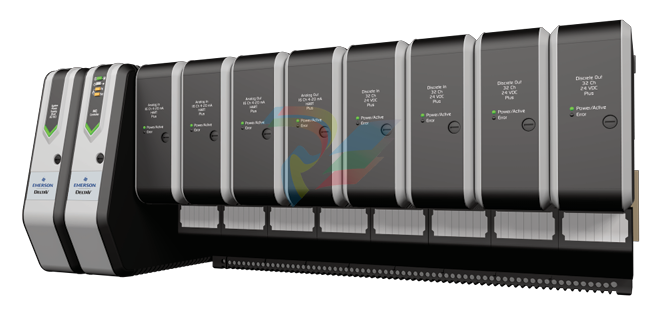
Traditional I/O is a modular subsystem that offers flexibility
during installation. It’s designed to be installed in the field,
near your devices. Traditional I/O is equipped with function
and field wiring protection keys to ensure that the correct I/O
card is always plugged into the corresponding terminal block.
Modularity, protection keys, and plug-and-play capabilities
make DeltaV™ Traditional I/O a smart choice for your process
control system
Benefits
Decreases capital equipment costs
Full system modularity: The Traditional I/O subsystem was
designed with your investment in mind. All components are
fully modular and may be installable under power. You add
I/O interface carriers and I/O interfaces in groups of 4, 8, 16,
or 32 channels as you need them. The modular design enables
you to purchase the exact amount of I/O cards, 8-wide or
4-wide carriers, power/ controllers, and 2-wide carriers you
need and add more DeltaV I/O as your system grows.
Reduced system footprint: The DeltaV system’s state-of-the-
art form factor design of the I/O components enables you to
mount the I/O interface carrier in a junction box in the field
so you significantly reduce the footprint of your equipment
and increase valuable control room space for other uses.
Installation: Save on wiring expenses by installing Classic
Instrumentation in the field, near the actual field devices.
Mounting the controller with the I/O further reduces your
wiring expenditures by eliminating the need for long runs
of multi-cores. The integrated design of the Traditional I/O
subsystem can eliminate the need for marshalling panels.
This saves you even more in your total capital costs.
The provision of in-line fuses and bussed power saves
on installation costs compared with external fuses and
power distribution.
Decreases installation time and expense
Plug-and-play installation saves money: All Traditional
I/O components plug into the I/O interface carrier. You can
install the I/O interface carriers to manage anticipated growth
and postpone the I/O interfaces until you’re ready to install
your additional field devices.
Phased installation saves time: As soon as you mount the
I/O interface carrier, you’re ready to begin installing the field
devices. I/O terminal blocks plug directly onto the I/O interface
carrier. There is no need to have the I/O cards installed.
Keys: Traditional I/O interfaces and terminal blocks have
I/O function keys. These keys ensure that the correct I/O
card is always plugged into the corresponding terminal block.
It’s incredibly easy to use and gives you time to do more.
This design enables you to initially install Traditional I/O
quickly and efficiently. When you need to replace an I/O card,
the function key design ensures that you will always install
it correctly. This keying system provides a safety measure
by preventing the wrong I/O interface’s being installed.
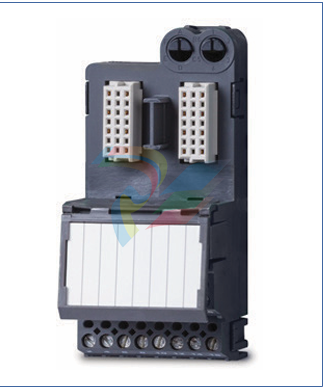
Traditional I/O terminal block.
Increases productivity
Real-time, online equipment additions: Online addition
of new I/O interfaces means your process does not get
interrupted. As new equipment is added, the DeltaV Explorer
acknowledges it and assigns it basic configuration.
Increases process availability
1:1 Redundancy for Traditional and HART I/O cards:
DeltaV redundant I/O uses the same Series 2 I/O cards as
non- redundant I/O. This allows you to leverage your investment
in installed I/O and in I/O spares. No additional configuration
is needed when using a redundant channel. The redundant
terminal blocks provide the same field wiring connections
as simplex blocks, so there is no extra wiring needed.
Autosense of redundancy: DeltaV autosenses redundant I/O,
which greatly simplifies the task of adding redundancy to the
system. The redundant pair of cards is treated as one card
in the system tools.
Automatic Switchover: Should a primary I/O card fail,
the system automatically switches to the “standby” card
without user intervention. The operator is given clear
notification of a switchover at the operator display
Product Description
The Traditional I/O subsystem includes:
I/O interface carrier (a DIN rail surface mounted)
on which all I/O related components are installed.
Bulk AC to 24V DC power supply for field devices.
An I/O interface consisting of an I/O card and an
I/O terminal block.
A variety of analog and discrete I/O cards enclosed
in a common form factor that easily plugs into the
I/O interface carrier.
A variety of I/O terminal blocks mounted on the I/O interface
carrier that can be pre-wired before I/O card installation.
I/O Cards
A variety of analog and discrete I/O cards are available to meet
your specific requirements. The following cards support simplex
or redundant installation:
AI 4-20 mA HART 8 channels
AO-4-20 mA HART 8 channels
DI, 24V DC Dry Contact, 8 channels
DO 24V DC High-Side, 8 channels
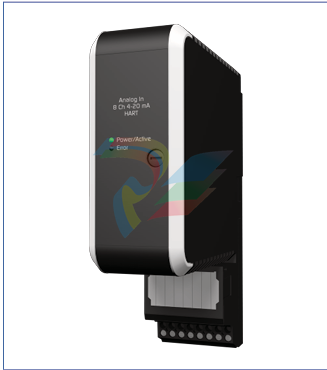
A Traditional I/O card easily plugs into an I/O carrier.
AI (Plus) 4-20 mA HART, 16 channels
AO (Plus) 4-20 mA HART, 16 channels
DI (Plus) 24V DC, Dry Contact, 32 channels
DO (Plus) 24V DC, High-Side, 32 channels
The following I/O cards are supported in simplex format
to meet your field wiring needs.
AI Isolated, 4 channels
RTD, 8-channels
Thermocouple, 8 channels
Millivolt, 8 channels
DI, High Density, 32 channels
DI 24V DC Isolated, 8 channels
Multi-Function, 4 channels (Isolated DI)
Sequence of Event, 16 channels (DI 24 V DC)
DI 120V AC Low Side Detection, 8 channels
DI 120V AC Isolated, 8 channels
DO 24V DC Isolated, 8 channels
DO 120/230V AC High-Side, 8 channels
DO 120/230 Isolated, 8 channels
All I/O cards are enclosed in a common form factor that plugs
into the I/O interface carrier. The housing is clearly labeled with
the enclosed I/O card type. All cards have power and internal
error indicators. Eight-channel cards have clearly visible channel
status LEDs.
All cards meet ISA G3 corrosion specifications by the careful
selection of superior electronic components and the use of
conformal coating.
Pulse Counters are available on most DI cards. The supported
maximum frequency varies from 0.1 Hz on AC signals to
75 or 120 Hz on 24V DC inputs. For higher pulse counts,
up to 50 KHz, use the Multi-Function card’s high speed
pulse input.
The DeltaV system provides control module level time
stamping for log events and alarms. For greater event
resolution, the 16-channel Sequence-of-Events DI card
can provide signal driven events to a resolution of +/- 0.25 ms
per card, or within 1 ms per controller. Please refer to
the Sequence-of-Events PDS for more information on
Sequence-of-Event data collection and system options
for this feature
The keying mechanism consists of two keying posts that rotate
and lock into the terminal block base. Each post has 6 positions:
A-F and 1-6. Each card is assigned a unique key, which is marked
on the side of the I/O card:
Terminal block keying example.
The keys prevent installation of an incorrect card, and the
graphical information on the card makes it easy to determine
if a keyed slot will accept a particular card.
There are different I/O terminal blocks available to meet the
wiring needs of field signals.
8-Channel terminal block
Fused 8-Channel terminal block
AI 8-Channel terminal block
2-wire AI Plus 16-Channel terminal block
4-wire AI Plus 16-Channel terminal block
AO Plus 16-Channel terminal block
DI 32-Channel terminal block
DI Plus 32-Channel terminal block
DO Plus 32-Channel terminal block
Isolated Input terminal block
RTD/Resistance terminal block
Thermocouple terminal block
The following redundant I/O terminal blocks are available
on some I/O interfaces, allowing a pair of cards to be installed
as a redundant pair.
Redundant AI 8-Channel terminal block
Redundant AI Plus 16-Channel terminal block
Redundant AO 8-Channel terminal block
Redundant AO Plus 16-Channel terminal block
Redundant Discrete 8-Channel terminal block
Redundant DI Plus 32-Channel terminal block
Redundant DO Plus 32-Channel terminal block
The table on the following page lists the compatible
terminal blocks for each card, along with the cards
unique key positions. The first terminal block listed
is the recommended terminal block.
In addition to standard signal wiring, some cards may also
be ordered with Mass Terminal blocks that allow these cards
to be connected to the M-series Mass Connection Solutions
or third party wiring solutions from Phoenix or if IS Barriers
are required from Pepperl and Fuchs, mounted in an adjacent
cabinet to meet special signal conditioning or for optimizing
field wiring solutions. Please refer to the Alliance Program
website for details on approved third-party products.
10-pin Mass Termination Block (simplex only)
16-pin Mass Termination Block (simplex only)
24-pin Mass Termination Block (simplex only)
40-pin Mass Termination Block (simplex and redundant)
48-pin Mass Termination Block (simplex and redundant)
-
CTI 2500S-27-1750 Slice I/O, Ethernet, RS232/485. 900MHz, 2DIO / 4UAI / 2AI
-
CTI 2500S-26-1750 Slice I/O, Ethernet, RS232/485. 900MHz, 8DIO / 2UAI
-
CTI 2500S-23-1750 Slice I/O, Ethernet, RS232/485. 900MHz, 4DI / 4DO / 2UAI / 2AO
-
CTI 2500S-27-1550 Slice I/O, RS232/485. 2DIO / 4UAI / 2AI
-
CTI 2500S-26-1550 Slice I/O, RS232/485. 8DIO / 2UAI
-
CTI 2500S-23-1550 Slice I/O, RS232/485. 4DI / 4DO / 2UAI / 2AO
-
CTI 2500S-27-1050 Slice I/O, Ethernet, 2DIO / 4UAI / 2AI
-
CTI 2500S-26-1050 Slice I/O, Ethernet, 8DIO / 2UAI
-
CTI 2500S-23-1050 Slice I/O, Ethernet, 4DI / 4DO / 2UAI / 2AO
-
CTI 2500C-32F-CJC 32-Pin Field Wiring Connector with Cold Junction Compensation
-
CTI 2500C-32F 32-Pin Field Wiring Connector
-
CTI 2500C-8-TC Eight Thermocouple Inputs
-
CTI 2500C-8-RTD Eight RTD Inputs
-
CTI 2500C-8-RL-FC 8 Form-C Relay Outputs
-
CTI 2500C-8-IDO-24V 8 Isolated 24VDC Outputs
-
CTI 2500C-8-IDO-120V 8 Isolated 120VAC Outputs
-
CTI 2500C-16-DO-24V Sixteen 24VDC Digital Outputs
-
CTI 2500C-16-DO-120V Sixteen 120VAC Digital Outputs
-
CTI 500C-16-IDI-24V Sixteen Isolated 24V AC/DC Digital Inputs
-
CTI 2500C-16-IDI-120V Sixteen Isolated 120V AC/DC Digital Inputs
-
CTI 2500C-16-DIDO-SIM Sixteen Digital Input and Output SImulator
-
CTI 2500C-16-DI-24V Sixteen 24V AC/DC Digital Inputs
-
CTI 2500C-16-DI-120V Sixteen 120V AC/DC Digital Inputs
-
CTI 2500C-RBC-RS485 RS485 Remote Base Controller
-
CTI 2500C-RBC-PRF Profibus Remote Base Controller
-
CTI 2500C-PS-24V-35 35-Watt DC Power Supply
-
CTI 2500C-PS-120V-35 35-Watt AC Power Supply
-
CTI 2500C-R8 Eight-Slot Base
-
CTI 2500C-R4 Four-Slot Base
-
CTI 2500C-R16 Sixteen-Slot Base
-
CTI 2500C-2572-B Fast Ethernet TCP/IP Adapter
-
CTI 2500C-J750 Compact Janus PAC with 3MB Project Memory
-
CTI 2500C-C300 CPU with 512K User Memory
-
CTI 2500C-C200 CPU with 256K User Memory
-
CTI 2500C-C100 CPU with 128K User Memory
-
CTI 2500C-8-AO 8 Analog Outputs
-
CTI 2500C-8-AI 8 Analog Inputs
-
CTI 2559-FCAL Precision Calibration Connector
-
CTI 2559-FPC 2559-FPC 40-pin screw terminal connector
-
CTI 2500-RFC PLC to RF Modem Cable
-
CTI 2500-40F 40-Position Standard Screw-Terminal Connector
-
CTI 2505 Vibration Sensor Interface Module
-
CTI 2554-A 4-Channel Isolated High Speed Counter Module
-
CTI 2553-A 2-Channel Mag Meter Input Module
-
CTI 2502 2-Channel High Speed Counter Input Module
-
CTI 2559-TC 8-Channel Thermocouple Input Module
-
CTI 2556-A 16-Channel Isolated Thermocouple Input Module
-
CTI 2556 16-Channel Isolated Thermocouple Input Module
-
CTI 2551-A 8-Channel Isolated Thermocouple Input Module
-
CTI 2559-RTD 8-Channel RTD Input Module
-
CTI 2557-A 16-Channel RTD Input Module
-
CTI 2557 16-Channel RTD Input Module
-
CTI 2552-A 8-Channel Isolated RTD Input Module
-
CTI 2534 8-Point Form-C Relay Output Module
-
CTI 2532 16-Point Form-A Relay Output Module
-
CTI 2531 32-Point Form-A Relay Output Module
-
CTI 2530 8-Point Form-C Relay Output Module
-
CTI 2562 8-Channel Analog Output Module
-
CTI 2560-A 8-Channel Isolated Analog Output Module
-
CTI 2501 8in/4out Analog Module
-
CTI 2558 8-Channel Analog Input Module
-
CTI 2555-A 16-Channel Analog Input Module
-
CTI 2550-A 8-Channel Isolated Analog Input Module
-
CTI 2599 8/16/32-Point AC Output Module
-
CTI 2598-8 8-Point AC Output Module
-
CTI 2598 8/16-Point AC Output Module
-
CTI 2597 8/16/32-Point DC Output Module
-
CTI 2596-8 8-Point DC Output Module
-
CTI 2596 8/16-Point DC Output Module
-
CTI 2595 16-Point TTL/Word Output Module
-
CTI 2591-EF 16-Point Isolated 11-146 VDC Output with Front Panel Accessible Fuses
-
CTI 2591-A 16-Point Isolated 11-146 VDC Output Module
-
CTI 2590-EF 16-Point Isolated 20-132 VAC Output with Front Panel Accessible Fuses
-
CTI 2590-A 16-Point Isolated Discrete 20-132 VAC Output Module
-
CTI 2589-B 8/16/32-Point Universal Discrete Input Module
-
CTI 2589-A 8/16/32-Point Universal Discrete Input Module
-
CTI 2588-8 8-Point Universal Discrete Input Module
-
CTI 2585 16-Point TTL/Word Input Module
-
CTI 2582 16-Point Isolated 125 VDC Input Module
-
CTI 2581 16-Point Isolated 12-56 VDC Input Module
-
CTI 2580 16-Point Isolated 95-132 VAC Input Module
-
CTI 2500-TAP RS485 Network Tap
-
CTI 2500-RIO-B RS485 Remote Base Controller
-
CTI 2500-RIO-A RS485 Remote Base Controller
-
CTI 2500-RBC Profibus Remote Base Controller
-
CTI 2515-A 100-Watt AC/DC Power Supply with Redundancy Support
-
CTI 2515 100-Watt AC Power Supply (MATURE - replaced by 2515-A)
-
CTI 2513-A 75-Watt DC Power Supply with Redundancy Support
-
CTI 2513 75-Watt 24VDC Power Supply
-
CTI 2512-A 75-Watt AC/DC Power Supply with Redundancy Support
-
CTI 2512 75-Watt AC/DC Power Supply
-
CTI 2510 125 VDC Power Supply
-
CTI 2500-SSB Single Slot Blank Front Panel
-
CTI 2500-R11-A Eleven-Slot Redundant Base
-
CTI 2500P-R16 Sixteen-Slot Base with High-Speed Channel
-
CTI 2500P-R8 Eight-Slot Base with High-Speed Channel
-
CTI 2500P-R4 Four-Slot Base with High-Speed Channel
-
CTI 2541 Redundant Processor Manager Module
-
CTI 2577 Profibus DP Slave Adapter
-
CTI 2573-MOD Serial Interface Adapter with MODBUS
-
CTI 2572-AF Fast Ethernet TCP/IP Adapter with Optical Fiber Connection
-
CTI 2572-A Fast Ethernet TCP/IP Adapter
-
CTI 2572 Ethernet TCP/IP Adapter
-
CTI 2572-B Fast Ethernet TCP/IP Adapter
-
CTI 2576 DeviceNet™ Scanner Module (MATURE)
-
CTI 2500P-ECC1 Ethernet Communications Coprocessor
-
CTI 2500P-JACP Janus Application Coprocessor
-
CTI 2500P-ACP1 Application Coprocessor (MATURE - replaced by 2500P-JACP)
-
CTI 2500P-J450 Janus PAC with 2MB Project Memory
-
CTI 2500-C400 CPU with 3072K User Memory
-
CTI 2500-C300 CPU with 512K User Memory
-
CTI 2500-C200 CPU with 256K User Memory
-
CTI 2500-C100 CPU with 128K User Memory
-
CTI 2500P-J750 Janus PAC with 3MB Project Memory
-
Shinkawa WHF3006M Displacement Converter
-
Shinkawa JBP-220 (P-24-94A / P-24-94B) Circuit Board Module
-
SHINKAWA WKN-142K5 2-WIRE VIBRATION TRANSDUCER
-
Shinkawa FRP-321 (P-26-54A / P-26-54B) Circuit Board Module
-
Shinkawa IOP-160 (P-25-72A / P-25-72B) Circuit Board Module
-
Shinkawa PK-147B-1 / PK-147A-1 Circuit Board Module
-
Shinkawa CPP-91A Circuit Board Module
-
Shinkawa FRP-177 PCB Module
-
Shinkawa CPP-127 (P-26-74A / P-26-74B) Circuit Board Module
-
Shinkawa FRP-227 (P-24-86A / P-24-86B) Circuit Board Module
-
Shinkawa MDP-104 (P-25-83A / P-25-83B) Circuit Board Controller
-
Shinkawa VK-143P2 High-precision eddy current sensor driver/signal conditioner
-
Shinkawa FRP-226 (P-24-86A / P-24-86B) Circuit Board Module
-
Shinkawa CPP-107A P-22-99A P-22-99B Circuit Board Module

Add: High-tech Software Park, Xiamen City, Fujian Province
Mobile: +86-17750019513(WhatsApp)
Email: yy4291644@gmail.com
Website: https://www.abb-sis.com
.jpg)
.jpg)
.jpg)
.jpg)
.jpg)
.jpg)

-
CTI 2500S-27-1750 Slice I/O, Ethernet, RS232/485. 900MHz, 2DIO / 4UAI / 2AI
-
CTI 2500S-26-1750 Slice I/O, Ethernet, RS232/485. 900MHz, 8DIO / 2UAI
-
CTI 2500S-23-1750 Slice I/O, Ethernet, RS232/485. 900MHz, 4DI / 4DO / 2UAI / 2AO
-
CTI 2500S-27-1550 Slice I/O, RS232/485. 2DIO / 4UAI / 2AI
-
CTI 2500S-26-1550 Slice I/O, RS232/485. 8DIO / 2UAI
