


- CTI
- SHINKAWA
- SEL
- ADLINK
- Jaquet
- ETEL
- Basler Electric
- Beckhoff
- DEIF
- SAUTER
- UNIOP
- Sieger
- Autronica
- SAMSUNG
- Stucke Elektronik
- Moore
- NI
- EMERSON
- IBA
- SST
- LEYBELOD
- SAMSUNG
- METSO
- AMAT
- Phoenix
- LAND
- LAMBDA
- Abaco
- Kongsberg
- ALFA LAVAL
- Pacific Scientific
- Others
- OMRON
- AMAT
- ICS Triplex
- Lam Research
- KUKA
- Hirschmann
- ELAU
- EATON
- Applicom
- Watlow Anafaze
- Meggitt Vibro-meter
- Carrier
- Other
- ROCKWELL
- Rolls-Royce
- SAACKE
- Yokogawa
- B&R
- Reliance Electric
- Seifert
- A-B
- Weimeide Metso
- KEBA
- HIMatrix
- Valmet
- Schneider
- Prosoft
- PEPPERL+FUCHS
- Honeywell
- Woodward
- GE
- GEA Westfalia Separator
- Bently Nevada
- ALSTOM
- Foxboro
- MOTOROLA
- Fanuc
- VMIC
- KOLLMORGEN
- SEW
- Rexroth
- AEROTECH
- TOSHIBA
- TmeIC
- Sumitomo
- SOCAPEL SOCASIN
- SMC
- Stromag
- SIEMENS
- SCHUMACHER
- ABB
- MOOG
- EPRO
- EMERSON
- Triconex
DEIF LSU-112DG Load sharing, paralleling & operation
LSU-112DG
Load sharing, paralleling & operation
DEIF's load sharing units offer load sharing in various ways between generators and interfaces to a governor through an electronic potentiometer (EPQ96-2 or EPN110DN).
DEIF’s load sharing units offer load sharing in various ways between generators and interfaces to a governor through an electronic potentiometer (EPQ96-2 or EPN110DN).
Suitable for control of diesel and gas generators, for instance, they can control the power unit in stand-alone mode (performing frequency control) or parallel with other power units (performing frequency and power control).
The units have built-in power and frequency transducers that enable connection of external equipment. Constant power or isochronous mode is also possible. Speed control is conducted by two relays.
Variants
LSU-112DG
Frequency and power control
LSU-113DG
Frequency and power control
With -P>
LSU-114DG
Frequency and power control
With start/stop
LSU-122DG
Reactive
U and Q control
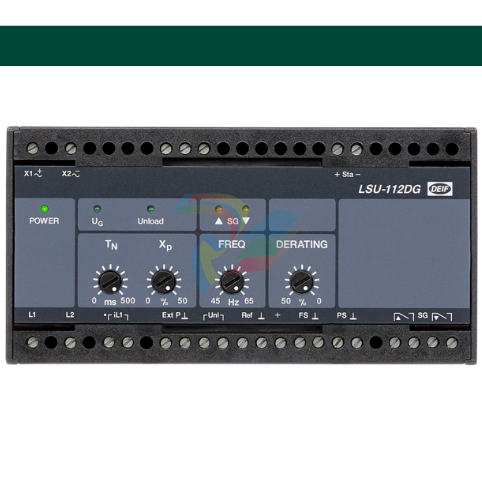
Application
The LSU-112DG is a control unit for control of the prime
mover in a power unit.
The LSU-112DG can control the power unit - - -
in stand-alone mode, performing frequency control
parallel with grid, performing power control
parallel with other power units, performing frequen
cy and power control
The unit is designed for connection to a mechanical
speed governor, however in conjunction with the DEIF
electronic potentiometer type EPN-110DN or EPQ-96 it
can control electronic speed governors as well.
The LSU-112DG has a built-in frequency transducer. If
a very stable frequency is wanted, an external frequen
cy transducer common for all the LSU-112DGs in the
power plant can be connected. If a number of power
units are to be synchronised to the busbar at the same
time, the frequency may likewise be controlled external
ly.
Function
The LSU-112DG is measuring the voltage and the
current from which the frequency and the power pro
duced by the power unit are measured. The built-in
power transducer is based on an I x cos phi principle.
The following couplings are available: - -
1W(4) – single phase
1W3 – 1-element 3-phase, 3-wire, balanced load
If unbalanced load can be expected, an external power
transducer with an output of 4 to 20 mA can be con
nected to the LSU-112DG. In this case the built-in I x
cos phi transducer is automatically interrupted.
The power and frequency measured by each LSU
112DG are fed to two paralleling lines for comparison
with the frequency (FS) and power (PS) of the other
connected LSU-112DG.
If L1 or L2 is disconnected from the LSU-112DG at the
same time as a power unit in a power plant is discon
nected from the power line (busbar), built-in relays in
the LSU-112DG ensure that the power output and the
frequency output of the associated unit are disconnect
ed from the paralleling lines. Likewise the power and
frequency outputs are disconnected if the auxiliary
voltage to the LSU-112DG is disconnected.
The LSU-112DG is equipped with an unload input.
When activated this input will control the power unit to
zero power, and at the same time the power output of
the LSU-112DG is disconnected from the paralleling
line.
The calibration of the LSU-112DG is done so it matches
its power unit. This means that load sharing between
power units with different size will be performed accord
ing to the actual size of the individual power unit in the
plant. For example a 100 kW PU and a 150 kW PU
running in parallel will share a total load of 125 kW into
50 kW and 75k W. If the 150 kW PU is derated to 100
kW by means of the DERATING potentiometer on the
front of the LSU-112DG, the load in the above example
will then be shared equally between the two power
units.
Regulator output
The unit is provided with two contact outputs for speed
control:
Power and frequency control:
The regulating speed of the servomotors for the prime
mover is controlled by the built-in P controller of the
LSU-112DG according to its setting for:
TN (min. ON time):
The min. duration of the control pulse when inside the
proportional band Xp.
XP (proportional band):
The zone within which the pulse/pause ratio changes
proportionally to the frequency/power deviation from the
required value.
TP (period time):
The time between the beginnings of two subsequent
relay pulses.
Deadband:
The zone within which no control pulses are emitted.
Self-monitoring
The LSU-112DG is equipped with a self-monitoring
function. The function supervises the built-in micro
controller and hereby verifies if the programme is run
ning correctly. The green LED marked “POWER” is
connected to this function. Constant green light indi
cates that the supply voltage is accepted and the unit is
running correctly. Flashing green light 2-3 Hz indicates
that the supply voltage is accepted but the unit is run
ning incorrectly. In this situation the status output termi
nals 17 and 18 are activated (open).
| User name | Member Level | Quantity | Specification | Purchase Date |
|---|


-
SEL SEL-T401L Ultra-High-Speed Line Relay
-
SEL-SEL-T400L Time-Domain Line Protection
-
SEL SEL-2664S Stator Ground Protection Relay
-
SEL-787-2/-3/-4 Transformer Protection Relay
-
SEL SEL-787 Transformer Protection Relay
-
SEL SEL-751 Feeder Protection Relay
-
SEL SEL-700G Generator Protection Relay
-
SEL-SEL-487E Transformer Protection Relay
-
SEL-SEL-400G Advanced Generator Protection System
-
SEL SEL-387E Current Differential and Voltage Relay
-
SEL-387A Current Differential and Overcurrent Relay
-
SEL SEL-387 Current Differential and Overcurrent Relay
-
SEL SEL-300G Generator Relay
-
SEL SEL-700BT Motor Bus Transfer Relay
-
CTI 2500 Series® Slice Ethernet Remote I/O System
-
CTI 500 Series® Compact Programmable Automation Control System
-
CTI 2500 Series® Classic Programmable Automation Control System
-
CTI 2500 Series® Bases
-
SHINKAWA VM-25 Condition Monitoring System UPDATED
-
SHINKAWA VM-5 SERIES OPTIONS
-
ABB SACO 64D4 Annunciator unit
-
ABB SPAU 140 C Synchro-check relay
-
HONEYWELL TDC 3000X Advanced Process Manager
-
HONEYWELL ENHANCED MICRO TDC 3000
-
VIBRO-METER VM600Mk2/ VM600 XMx16 + XIO16T extended condition monitoring modules
-
VIBRO-METER VM600Mk2/ VM600 RPS6U rack power supplies
-
VIBRO-METER VM600Mk2/ VM600 ABE056 slimline rack
-
VIBRO-METER VM600Mk2 RLC16Mk2 relay modules
-
VIBRO-METER VM600Mk2 MPC4Mk2 + IOC4Mk2 machinery protection and condition monitoring modules
-
VIBRO-METER VM600Mk2 CPUMMk2 + IOCNMk2 rack controller and communications interface module
-
VIBRO-METER VM600Mk2 CPUMMk2 + IOCNMk2 rack controller and communications interface module
-
ADLINK cPCI-8168 Advanced 6U CompactPCI 8-axis Motion Controller with One HSL Network
-
ADLINK PCI/PCIe-7300A, cPCI-7300 32-CH 80 MB/s High-Speed Digital I/O Cards
-
ADLINK cPCI-7248/7249R 48-CH DIO & Timer/Counter Cards
-
ADLINK PCI-7230/7233/7234. LPCI/LPCIe/cPCI-7230 32-CH Isolated DIO Cards
-
ADLINK cPCI-6965 Series Value 6U CompactPCI® Intel® Core™2 Duo
-
ADLINK cPCI-6910 Series 6U CompactPCI® Dual-Core Intel® Xeon® Processor LV / ULV Universal Blade
-
ADLINK CPCI-6670 6U CompactPCI Low Power Pentium® III SBC
-
ADLINK cPCI-6625/6 Series6U CompactPCI® PlusIO blade with Intel® Core™ i7/i3 Processor
-
ADLINK 3U CompactPCI CPU Modules
-
ADLINK CM-435 Extreme Rugged™ PC/104 Single Board Computer
-
ADLINK Centralized Motion Controllers PCI-8254/8258
-
ADLINK NuPRO-E43 PICMG® 1.3 Full-Size LGA1151 with 6th/7th Generation Intel® Core™ i7/i5/i3o
-
ADLINK DLAP-211-JNX/DLAP-211-JT2/ DLAP-211-Nano
-
نظام التحكم الرقمي في التحفيز الكهربائي BASLER DECS-200
-
Hirschmann RS30-1602O6O6SDAE compact OpenRail managed Ethernet switches
-
Hirschmann RS30-0802O6O6SDAE Ethernet switch
-
Hirschmann RS20-1600T1T1SDAE Management-type Ethernet switch
-
Hirschmann OCTOPUS 24M Limited Availability/Passive
-
Hirschmann MSP30-24040SCZ9MRHHE3A
-
Hirschmann MAR1040-4C4C4C4C9999SMMHRHHXX.X. Gigabit Ethernet Switch configurator
-
Hirschmann Industrial Ethernet Rail Switch SPIDER II, SPIDER II Giga, SPIDER II PoE
-
Hirschmann Industrial Ethernet Firewall EAGLE One
-
Hirschmann Industrial Security Router EAGLE20/30
-
Hirschmann Description and operating instructions RS2-xTX/xFX EEC
-
Basler Electric DIGITAL EXCITATION CONTROL SYSTEM DECS-300
-
Basler Electric DECS-200 Digital Excitation Control System
-
Basler Electric GENERATOR PROTECTION SYSTEM BE1-GPS100
-
Jaquet FT3000 Speed measurement system
-
Hirschmann Industrial Ethernet Ruggedized Switch MACH1000 Family
-
Basler Electric BESTCOMSPlus®
-
ETEL AccurET MODULAR 300 EA-P2M-300-xxxxxA controller
-
Basler Electric ES Series Protection Relays
-
ABB Multifunction Protection and Switchbay Control Unit REF542plus
-
EMERSON AMS 2140 Machinery Health Analyzer
-
Hirschmann Industrial Ethernet Rail Switch RS20 Basic Family
-
GE Grid Solutions P40U Px40 USB Adaptor
-
ABB ontinuous Gas Analyzers AO2000 Series AO2040CU Ex Central Unit in Category 2G
-
ABB Advance Optima AO2000 Series Continuous gas analyzers Models AO2020. AO2040
-
ABB Advance Optima Module Uras 14
-
SAACKE control optimization
-
SAACKE se@vis efficiency monitor
-
SAACKE se@vis pro
-
SAACKE se@vis eco
-
SAACKE se@vis compact
-
HIRSCHMANN Industrial ETHERNET Switch MICE MS20/MS30
-
HIRSCHMANN MICE Media modules
-
Kongsberg GL-10 Level Switch
-
B&R ACOPOSinverter P74 frequency converter
-
Beckhoff CX2020 | Basic CPU module (service phase)
-
Beckhoff CX1010 | Basic CPU module (service phase)
-
Beckhoff CX5120 | Embedded PC with Intel Atom® E3815
-
Beckhoff CP69xx-xxxx-0010 | Economy built-in Control Panel with DVI/USB Extended interface
-
Beckhoff CP29xx-0000 | Multi-touch built-in Control Panel with DVI/USB Extended interface
-
SAACKE Monoblock Rotary Cup Burner SKVJ-M
-
ABB Plantguard Fault Tolerant Technology Architecture and Software
-
OMRON H8PR-8/H8PR-8P H8PR-16/H8PR-16P H8PR-24/H8PR-24P Rotary Positioner
-
ABB PFSA107-Z42 DTU Stressometer Digital Transmission Unit
-
Nidec Mentor MP
-
IBA PC connection for high-precision data acquisition with ibaNet-E
-
IBA FO Connection to Reflective Memory
-
IBA FO Connection to Siemens Systems
-
IBA Interface Cards For Fiber Optic Connections
-
IBA Field and Drive Buses
-
IBA ibaPADU-S Modular System
-
IBA ibaMAQS
-
STUCKE SYMAP®ARC
-
STUCKE SYMAP®R
-
STUCKE SYMAP®Compact
-
MOOG G123-825-001 BUFFER AMPLIFIER
-
Motorola MVME5100 Series VME Processor Modules
-
ABB MEASUREMENT & ANALYTICS NGC8209 Natural gas chromatograph
-
Motorola MVME162 Embedded Controller
-
HIMatrix Safety-Related Controller System Manual for the Modular Systems
-
MOTOROLA MVME2400 Series VME Processor Module
-
Sieger System 57
-
KONGSBERG MRU product line continuation
-
Woodward easYgen-3100/3200 Genset Control for Multiple Unit Operation
-
Woodward MFR 300 Multifunction Relay / Measuring
-
ABB AX410, AX411, AX416, AX450 and AX455 Single and dual input analyzers
-
Woodward easYgen-1400 Technical Manual Genset Control
-
Woodward easYgen-400 Operation Manual Genset Control
-
Woodward High Output Digital Valve Positioner (DVP) DVP5000/DVP10000/DVP12000
-
Woodward High Output Digital Valve Positioner DVP5000 and DVP10000
-
Woodward TG611-13/-17 Overspeed Test Device Conversion Kit
-
Woodward MicroNet Safety Module (MSM)
-
Woodward 2301A Electronic Load Sharing and Speed Control 9905/9907 Series
-
Woodward-Service Bulletin 01671
-
UniOP eTOP40B 12.1” TFT color display
-
UniOP eTOP40 TFT Color display
-
UniOP eTOP33B 10.4” TFT color display
-
UniOP eTOP33C eTOP33-0050 Resistive touchscreen
-
UniOP eTOP30. eTOP32 eTOP32-0050 Human-machine interface equipment
-
UniOP eTOP20B and eTOP21B eTOP20B-0050
-
UniOP eTOP12 eTOP12-0050 Advanced human-machine interface equipment
-
UniOP eTOP11 eTOP11-0050 HMI
-
UniOP eTOP06 HMI
-
UniOP eTOP05EB eTOP05EB-DF45 HMI

Add: High-tech Software Park, Xiamen City, Fujian Province
Mobile: +86-17750019513(WhatsApp)
Email: yy4291644@gmail.com
Website: https://www.abb-sis.com



-
DEIF FAS-113DG Synchronisation & circuit breaker closing
-
DEIF FAS-115DG Synchronisation & circuit breaker closing
-
DEIF HAS-111DG Synchronisation & circuit breaker closing
-
DEIF LSU-122DG Load sharing, paralleling & operation
-
DEIF LSU-114DG Load sharing, paralleling & operation
