

GE VMIVME-7807 VME-7807RC* Intel® Pentium® M-Based VME SBC
Pentium® M-based, single board computers (SBCs) in a single-slot, passively cooled,
VME Eurocard form factor. These products utilize the advanced technology of Intel®’s
855GME chipset.
VMIVME-7807
VME-7807RC*
Intel® Pentium® M-Based VME SBC
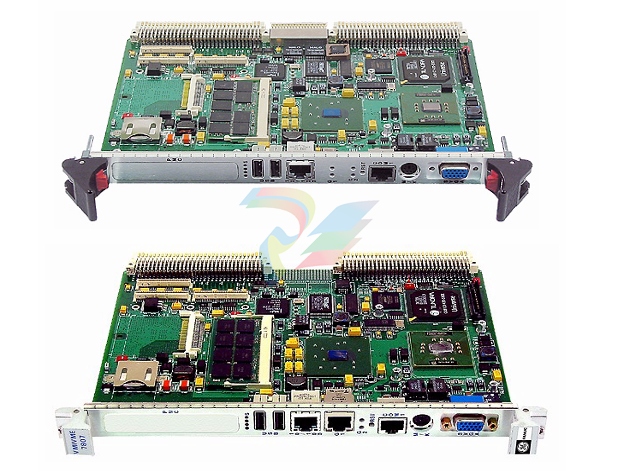
GE Fanuc Embedded Systems’ VMIVME-7807/VME-7807RC are full featured
Pentium® M-based, single board computers (SBCs) in a single-slot, passively cooled,
VME Eurocard form factor. These products utilize the advanced technology of Intel®’s
855GME chipset.
The VMIVME-7807/VME-7807RC provide features typically found on desktop
systems such as:
• 1.0GB DDR SDRAM using one SODIMM and an optional 512MB of solder-in
memory for a maximum of 1.5GB
• Built-in SVGA support (front panel connection)
• Digital video controller (rear I/O) DVI-D with dual head display capabilities
• 10/100 Mbit Ethernet controller (front panel connection)
• Dual Gigabit Ethernet supporting (front panel or rear I/O)
• Optional P0 with VITA 31.1 interface
• Serial ATA (SATA) support (rear I/O)
• Serial port COM1 (front panel connection)
• Ultra IDE drive support (rear I/O)
• Real-Time clock/calendar
• Front panel reset switch
• Miniature speaker
• Keyboard/Mouse port (front panel connection)
The 855GME chipset allows the VMIVME-7807/VME-7807RC to provide enhanced
features such as integrated video and Ultra ATA/100 IDE support. The
VMIVME-7807/VME-7807RC are capable of executing many of today’s desktop
operating systems such as Microsoft®’s Windows® XP, Windows 2000 and a wide
variety of Linux® based operating systems. The standard desktop features of the
VMIVME-7807/VME-7807RC are described in Chapter 2 of this manual.
The VMIVME-7807/VME-7807RC provide features useful to embedded applications
such as:
• Three serial ports: COM2. COM3 and COM4 (rear I/O)
• Four USB 2.0 ports (two on front panel and two rear I/O)
• 32KB of nonvolatile RAM
• Remote Ethernet booting
• Up to 2GB of CompactFlash on secondary IDE (optional)
• Software-selectable Watchdog Timer with reset
Additionally, the VMIVME-7807/VME-7807RC offer one PMC expansion site (PCI-X,
66MHz) with front panel access. The VMIVME-7807/VME-7807RC are capable of
executing many of today’s operating systems such as VxWorks®, Solaris™ or QNX®.
The embedded features of the VMIVME-7807/VME-7807RC are described in
Chapter 3 of this manual.
The VMIVME-7807/VME-7807RC are suitable for use in applications ranging from
telecommunications, simulation, instrumentation, industrial control, process control
and monitoring, factory automation, automated test systems, data acquisition
systems and anywhere that the highest performance processing power in a single
VME slot is desired.
The VMIVME-7807/VME-7807RC conform to the VME physical specification for a 6U
board. The VMIVME-7807/VME-7807RC can be used for system control or as a
peripheral board. They can be plugged directly into any standard chassis accepting
either type of board.
The following steps describe the GE Fanuc Embedded Systems-recommended
method for installation and powerup of the VMIVME-7807/VME-7807RC :
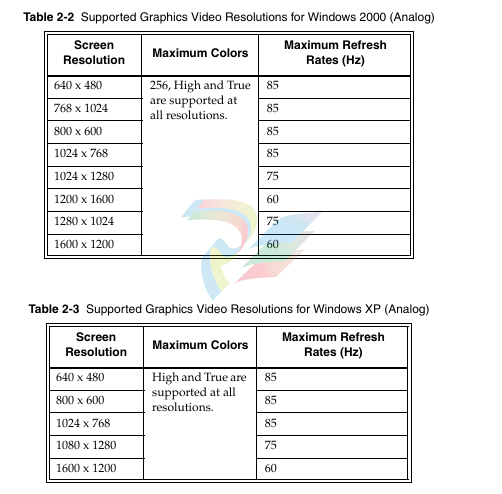
1. If a PMC module is to be used, connect it to the VMIVME-7807/VME-7807RC
prior to board installation (as shown in Figure 1-2 on page 29). Refer to the
Product Manual for the PMC module for configuration and setup.
2. Insert the VMIVME-7807/VME-7807RC into a VME chassis system controller or
peripheral slot. While ensuring that the board is properly aligned and oriented
in the supporting board guides, slide the board smoothly forward against the
mating connectors. Use the ejector handles to firmly seat the board.
3. All needed peripherals can be accessed from the front panel or the rear I/O
VMIACC-0586/ACC-0586RC or VMIACC-0590/ACC-0590RC Rear Transition
Modules (RTMs). Each connector is clearly labeled on the front panel and
detailed pinouts are in Appendix A.
4. Connect a keyboard and mouse if the system has not been previously
configured.
5. The VMIVME-7807/VME-7807RC feature an optional CompactFlash Disk
resident on the board. Refer to Chapter 3 for set up details.
6. If an external drive module is installed, the BIOS Setup program must be used to
configure the drive types. See Appendix B to properly configure the system.
7. If a drive module is present, install the operating system according to the
manufacturer’s instructions.
The VMIVME-7807/VME-7807RC have an onboard BIOS Setup program that controls
many configuration options. These options are saved in a special non-volatile,
battery-backed memory chip and are collectively referred to as the board’s ‘CMOS
Configuration’. The CMOS configuration controls many details concerning the
behavior of the hardware from the moment power is applied.
Details of the VMIVME-7807/VME-7807RC BIOS setup program are included in
Appendix B.
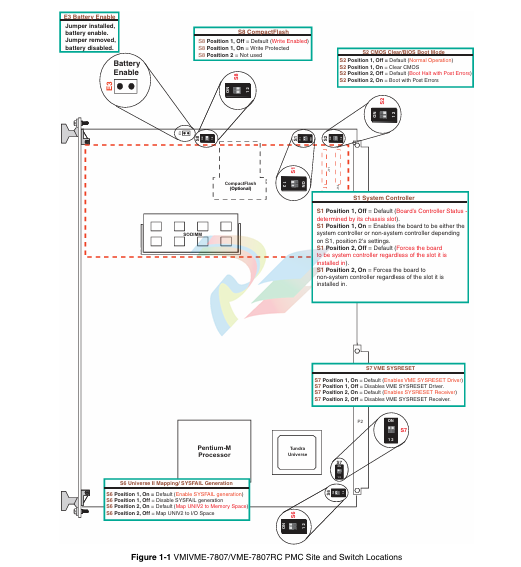
The VMIVME-7807/VME-7807RC provide front panel access for the PMC expansion
site, an optional Gigabit Ethernet port, one 10/100 RJ45 connector, one serial port,
SVGA, keyboard/mouse, the manual reset switch and the status LEDs. A drawing of
the VMIVME-7807/VME-7807RC front panels are shown in Figure 1-5. The front
panel connectors and indicators are labeled as follows:
• 10/100
• G1
• G2
• M/K
• COM1
•RST
• S
• SVGA
10/100 Mbit Ethernet connector
10/100/1000 Mbit Ethernet connector 1 (or LEDs) port 1
10/100/1000 Mbit Ethernet LEDs port 2
Mouse/keyboard connector
Serial Port
Manual reset switch
Status LEDs
Analog Video connector
The VMIVME-7807/VME-7807RC provide rear I/O support for the following: digital
video, Serial ATA, COM2. 3 and 4. IDE drive and two USB ports. These signals are
accessed by the use of an RTM such as the VMIACC-0586/ACC-0586RC and the
VMIACC-0590/ACC-0590RC, which terminates into industry standard connectors.
The front panel connectors, including connector pinouts and orientation, for the
VMIVME-7807/VME-7807RC are defined in Appendix A. Rear panel connections are
defined in the appropiate RTM Installation Guide. Contact Sales for compatible RTMs
offered by GE Fanuc Embedded Systems
The VMIVME-7807/VME-7807RC are Pentium M processor-based single board
computers compatible with modern industry standard desktop systems. The
VMIVME-7807/VME-7807RC therefore retain industry standard memory and I/O
maps along with a standard interrupt architecture. The integrated peripherals
described in this section (such as serial ports, USB ports, IDE drives, floppy drives,
video controller and Ethernet controller) are all memory mapped the same as
similarly equipped desktop systems, ensuring compatibility with modern operating
systems.
The following sections describe the standard features of the
VMIVME-7807/VME-7807RC
The VMIVME-7807/VME-7807RC provide DDR Synchronous DRAM (SDRAM) as
onboard system memory. Memory can be accessed as bytes, words or longwords.
The VMIVME-7807/VME-7807RC accept one 200-pin DDR SDRAM SODIMM along
with the optional solder-in 512MB onboard memory, for a maximum capacity of
1.5GB. The onboard DRAM is accessible to the VME through the PCI-to-PCI bridge
and is addressable by the local processor.
The PCI bus-based external devices include the Universe IID bridge, PMC site,
Ethernet controllers, FPGA and the GE Fanuc Embedded Systems connector. The
default BIOS maps these external devices to the PCI Interrupt Request (PIRQx) lines
of the 6300ESB I/O controller Hub. This mapping is defined in Table 2-1
The VMIVME-7807/VME-7807RC incorporate an SMSC Super I/O (SIO) chip. The
SIO provides the VMIVME-7807/VME-7807RC with two 16550 UART-compatible
serial ports, keyboard and mouse port. The keyboard and mouse ports are available
via the front panel using a standard PS/2 type connector. COM1 is accessed via the
front panel. COM2 is routed to the VME P2 connector.
COM ports 3 and 4 are also provided by the 6300ESB I/O Controller Hub and are
routed to the VME P2 connector.
The parallel IDE interface is provided by the Intel 6300ESB I/O Controller Hub. The
IDE interface supports two channels: primary and secondary. The secondary channel
is routed onboard to the optional CompactFlash socket. The primary channel is routed
out of the VME P2 backplane connector to an RTM which terminates into a standard
40-pin header. This channel can support a master and slave drive. The IDE interface
on the VMIVME-7807/VME-7807RC supports Ultra ATA/33. Ultra ATA/66 and Ultra
ATA/100 drives and automatically determines the proper operating mode based on
the type of drive used. In order to properly function in the Ultra ATA/100 mode, a
special 80 conductor cable must be used instead of the standard 40 conductor cable.
This cable is typically available from the Ultra ATA/100 drive manufacturer.
A Serial ATA Drive Interface is also provided by the 6300ESB I/O Controller Hub. The
Serial ATA port can be used alone or in limited conjunction with the parallel IDE
interface.
The network capability is provided by the Intel 82546EB for the VMIVME-7807 or the
Intel 82546GB for the VME-7807RC Ethernet Controller for Gigabit Ethernet and the
Intel 82551 10/100 Mbit Ethernet. These Ethernet controllers are PCI bus based and
are software configurable. The VMIVME-7807/VME-7807RC supports 10BaseT,
100BaseTX and 1000BaseT Ethernet.
10BaseT
A network based on the 10BaseT standard uses unshielded twisted-pair cables,
providing an economical solution to networking by allowing the use of existing
telephone wiring and connectors. The RJ45 connector is used with the 10BaseT
standard. 10BaseT has a maximum length of 100 meters.
100BaseTX
The VMIVME-7807/VME-7807RC also supports the 100BaseTX Ethernet. A network
based on a 100BaseTX standard uses unshielded twisted-pair cables and a RJ45
connector. 100BaseTX has a maximum length of 100 meters.
1000BaseT
The VMIVME-7807/VME-7807RC support 1000BaseT Ethernet using the Intel
82546EB for the VMIVME-7807 or the Intel 82546GB for the VME-7807RC dual
Ethernet controller. The interface uses shielded cables with four pairs of conductors,
along with an RJ45 connector on the front panel or routed to the VME P2 connector.
The Gigabit Ethernet is also available with the optional VITA 31.1 routed out of the
optional P0 connector
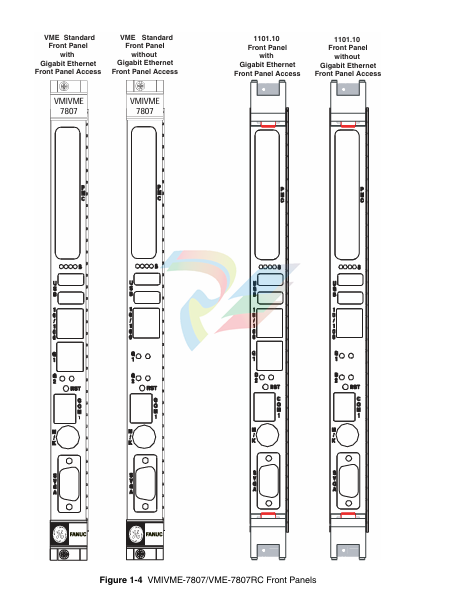
The SVGA port on the VMIVME-7807/VME-7807RC is controlled by the Intel
855GME Graphic and Memory Controller Hub (GMCH). The GMCH is hardware and
BIOS compatible with the industry SVGA and digital video standards supporting
both VESA high-resolution and extended video modes. Table 2-2 and Table 2-3 show
the graphics video modes supported by the GMCH video controller for analog
monitors
Digital Visual Interface (DVI)
2
The VMIVME-7807/VME-7807RC have a Digital Visual Interface that provides a
high-speed digital connection for visual data types that are display technology
independent. DVI is a display interface developed in response to the proliferation of
digital flat-panel displays. For the most part, these displays are currently connected to
an analog Video Graphics Array (VGA) interface and, thus, require a double
conversion.
The digital signal from the computer must be converted to an analog signal for the
analog VGA interface, then converted back to a digital signal for processing by the
flat-panel display. This inherently inefficient process takes a toll on performance and
video quality and adds cost. In contrast, when a flat-panel display is connected to a
digital interface, no digital-to-analog conversion is required.
DVI uses Silicon Image's PanelLink, a high-speed serial interface that uses Transition
Minimized Differential Signaling (TMDS) to send data to the monitor. The DFP and
VESA Plug and Display interfaces also use PanelLink. For this reason, DVI can work
with these previous interfaces by using adapter cables (depending on the signal
quality of the adapter.)
DVI also supports the VESA Display Data Channel (DDC) and the Extended Display
Identification Data (EDID) specifications. DDC is a standard communications channel
between the display adapter and monitor. EDID is a standard data format containing
monitor information such as vendor information, monitor timing, maximum image
size, and color characteristics. EDID information is stored in the display and is
communicated over the DDC. EDID and DDC enable the system, display and
graphics adapter to communicate so that the system can be configured to support
specific features available in the display.
DVI Connectors
The DVI connector has 24 pins that can accommodate up to two TMDS links and the
VESA DDC and EDID services. The DVI specification defines two types of connectors
(see Figure 1):
• DVI-Digital (DVI-D) supports digital displays only (used on the
VMIVME-7807/VME-7807RC)
• DVI-Integrated (DVI-I) supports digital displays and is backward compatible
with analog displays (not supported)
The VMIVME-7807/VME-7807RC use the DVI-I connector with a single TMDS link.
The DVI-I interface accommodates a 12- or 24-pin DVI plug connector or a new type
of analog plug connector that uses four additional pins, plus a ground plane plug to
maintain a constant impedance for the analog RGB signals
Dual Head Video
The VMIVME-7807/VME-7807RC are capable of driving two monitors at the same
time using the Intel 855GME GMCH. The graphics controller allows the use of one
digital monitor connected to the VMIACC-0590/ACC-0590RC or VMIACC-0586/
ACC-0586RC RTMs, routed out the rear I/O P2 connector. The second is a standard
SVGA monitor connected to the front panel of the VMIVME-7807/VME-7807RC,
using a standard DB15 connector.
Dual Head Setup Procedure:
1. Boot Windows 2000.
2. In the windows desktop right click.
3. When the menu appears, scroll down to the ‘Graphics Options’ and then click
on ‘Graphics Properties’. The Intel 82852/82855GM/GME graphics controller
properties menu will appear. From this menu you can choose the display mode
of choice.
The monitors can be displayed in several modes:
• Monitor Mode - In this mode only the SVGA monitor is displayed.
• Digital Mode - In this mode only the Digital is displayed.
• Dual Display Clone Mode - In this mode both the SVGA and the Digital
monitors are displayed, with the desktop the same on both monitors.
• Extended Desktop Mode - In this mode the two monitors are displayed as one
desktop.
4. After making your choice click ‘OK’ to apply the changes.
-
ADLINK 6U Enclosures & Systems cPCIS-6400X Series
-
ADLINK 6U Enclosures & Systems cPCIS-6400U Series
-
ADLINK 6U Enclosures & Systems cPCIS-6418U
-
ADLINK 6U Enclosures & Systems cPCIS-3300BLS
-
ADLINK 6U Enclosures & Systems cPCIS-3320/AC
-
ADLINK Power Supplies cPS-H640/AC
-
ADLINK Power Supplies cPS-H640/48
-
ADLINK 6U Rear Transition Modules cPCI-R6100 Series
-
ADLINK 6U Rear Transition Modules cPCI-R6002 Series
-
ADLINK 6U Rear Transition Modules cPCI-R6600 Series
-
ADLINK 6U CompactPCI 2.0 Blades cPCI-6660
-
ADLINK 6U CompactPCI 2.0 Blades cPCI-6636(KL) Series
-
ADLINK 6U CompactPCI 2.0 Blades cPCI-6640 Series
-
ADLINK 6U CompactPCI 2.0 Blades cPCI-6540 Series
-
ADLINK CompactPCI Backplanes cBP-3064
-
ADLINK CompactPCI Backplanes cBP-3213PR
-
ADLINK 3U Enclosures & Systems cPCIS-2500 Series
-
ADLINK 3U Enclosures & Systems cPCIS-2630 Series
-
ADLINK 3U Enclosures & Systems cPCIS-2632 Series
-
ADLINK 3U Enclosures & Systems cPCIS-2642 Series
-
ADLINK U Enclosures & Systems cPCIS-2633 Series
-
ADLINK U Enclosures & Systems cPCIS-ET1100 Series
-
ADLINK Power Supplies cPS-H325/AC
-
ADLINK Power Supplies cPS-H325/48
-
ADLINK Power Supplies cPS-H325/110
-
ADLINK Power Supplies cPS-H325/24
-
ADLINK PCI-7841/cPCI-7841 Dual-port Isolated CAN Interface Cards
-
ADLINK Peripherals & Accessories cPCI-3548
-
ADLINK Peripherals & Accessories cPCI-8301
-
ADLINK Peripherals & Accessories cPCI-3W10
-
ADLINK Analog Output cPCI-6208/6216 Series
-
ADLINK Multi-Function DAQ cPCI-9116
-
ADLINK 3U CompactPCI Blades CT-3620
-
ADLINK 3U CompactPCI Blades cPCI-3620
-
ADLINK 3U CompactPCI Blades cPCI-3620
-
ADLINK 3U CompactPCI Blades cPCI-3630
-
ADLINK 3U CompactPCI Blades cPCI-3640 Series
-
3U CompactPCI Blades cPCI-3520 Series
-
ADLINK IMB-M42H ATX Motherboards
-
Adlink PCIe-GIE74 /PCIe-GIE74V Frame Grabbers / Video Capture Cards
-
ADLINK USB-1605 Removable screw terminal blocks or high-density D-Sub
-
Adlink ETX-NR667-L7400/LXE ETX Module
-
ADLINK NuPRO-842LV/P industrial control motherboard
-
ADLINK cPCI-8994 Serial Communication
-
ADLINK / PCI-7432 Digital I/O
-
ADLINK IEC-915GV Compact industrial-grade fanless embedded system
-
ADLINK ADLINK, PLX / PCI-7296 Digital I/O
-
ADLINK HPCI-14S12U 0040 Backplane Selection Guide
-
ADLINK MXE-5500 /MXE-5501/M16G (G) Fanless Embedded Computer
-
Adlink Multi-Function DAQ PCI-9112
-
ADLINK NuPRO-852LV Control Board
-
ADLINK CompactPCI cPCI-7432R Digital I/O Module
-
ADLINK NUPRO-E320LV PICMG Single Board Computers
-
ADLINK PICMG Single Board Computers NuPRO-E72
-
ADLINK PICMG Single Board Computers NuPRO-865
-
Vibro-Meter Rack VM600SYSMK2-ABE04x 6U 19-inch rack Mk2 system
-
Vibro-Meter Relay expansion RLC16 Mk2 SIL2 (single card) 600-044L
-
Vibro-Meter Relay expansion RLC16 Mk2 SIL2 600-04
-
Vibro-Meter Relay expansion RLC16 Mk2 600-045L
-
Vibro-Meter Relay expansion RLC16 Mk2 600-045
-
Vibro-Meter I/O interface card IOCN Mk2 600-051
-
Vibro-Meter CPU controller CPUM Mk2 600-050
-
Vibro-Meter I/O interface card IOC10 Mk2 (rear card) 600-046
-
Vibro-Meter Temperature / Analog Acquisition AMC10 Mk2 600-042
-
Vibro-Meter I/O interface card IOC4 Mk2 600-043
-
Vibro-Meter Protective measuring card MPC4 Mk2 SIL2 601-041-A10
-
Vibro-Meter Protective measuring card MPC4 Mk2 601-041-A0
-
Vibro-Meter PSU-VM600 VM600 Rack Power Module
-
Vibro-Meter ABE056 - 1U ultra-thin single-rack
-
Vibro-Meter ABE046 - 6U 19-inch rack
-
Vibro-Meter ABE045 - 6U 19-inch rack
-
Vibro-Meter ABE044 - 6U 19-inch rack (with expansion slots)
-
Vibro-Meter ABE042 6U 19-inch rack (4 slots)
-
Vibro-Meter I/O interface card XIO16T
-
Vibro-Meter XMC16 16-channel combustion monitoring card
-
Vibro-Meter XMV16 - 16-channel vibration condition monitoring card
-
Vibro-Meter RLC16 Relay Card
-
Vibro-Meter IRC4 Intelligent Relay Card
-
Vibro-Meter IOCR2 input/output rear interface card
-
Vibro-Meter CPUR2 Central Processing and Controller Card
-
Vibro-Meter I/O interface card - IOCR
-
VIBRO-METER CPU controller CPUR
-
VIBRO-METER IOCN 200-585-000-322 I/O interface card
-
VIBRO-METER IOCN 200-585-000-321 I/O Interface Card
-
VIBRO-METER 200-595-074-323 VM600 system CPU management card, non-redundant
-
VIBRO-METER CPUM 200-595-074-322 CPU Controller
-
VIBRO-METER CPU controller CPUM 200-595-070-321
-
Vibro-Meter IOC8T VM600 Mk1 I/O Interface Card
-
Vibro-Meter AMC8 Analog Monitoring Card
-
VIBRO-METER IOC4G2 I/O interface card
-
VIBRO-METER MPC4G2 Protective measuring card
-
VIBRO-METER IOC4T 200-560-101-017 VM600 Mk1 Isolated I/O Interface Card, equipped with MPC4
-
VIBRO-METER IOC4T 200-560-101-015 VM600 Mk1 interface card
-
VIBRO-METER IOC4T 200-560-000-114 I/O interface card
-
VIBRO-METER IOC4T 200-560-000-113 I/O interface card
-
VIBRO-METER IOC4T 200-560-000-111 Sensor wiring
-
VIBRO-METER MPC4 200-510-072-212 Protection Measurement Card
-
VIBRO-METER MPC4 200-510-071-114 Protective Measurement Card
-
VIBRO-METER 200-510-071-111 4-channel vibration protection + 2-speed channels
-
VIBRO-METER 200-510-070-111 4-channel vibration protection + 2-speed channels
-
ADLINK PICMG Single Board Computers NuPRO-E315
-
ADLINK High Speed Link (HSL) PCI-7853
-
ADLINK Digital I/O PCIe-7432
-
ADLINK Mini-ITX Embedded Boards AmITX-AL-I
-
ADLINK 6U CompactPCI 2.0 Blades cPCI-6860A
-
ADLINK NuPRO-900A PICMG Single Board Computers
-
ADLINK Analog Output PCI-6308 Series
-
ADLINK USB DAQ USB-2405
-
ADLINK CRR-LX800-E-500 Compact Industrial Computer Module (COM)
-
ADLINK 15-slot 6U PXI/CompactPCI Chassis with AC PXIS-3320
-
ADLINK NUPRO-842 PICMG Single Board Computers
-
ADLINK PCI-8124-C Advanced 4-CH Encoder Card
-
ADLINK PCI-8102 Centralized Motion Controllers PCI-8102
-
ADLINK PCIe-7200 High-Speed DIO
-
SEL SEL-7201 Feeder Protection Panel
-
SEL SEL-7206 Distribution Bus Differential Protection Panel
-
SEL SEL-4388 Mirrored Bits Tester
-
SEL SEL-T4287 Traveling-Wave Test System
-
SEL SEL-4000 Relay Test System
-
SEL SEL-9510 Control Switch Module
-
SEL SEL-9502 Contact Arc Suppressor
-
SEL SEL-9501 Contact Arc Suppressor
-
SEL SEL-2652 Trip Coil Monitor
-
SEL SEL-2894 Interface Converter
-
SEL SEL-2890 Ethernet Transceiver
-
SEL SEL-2886 EIA-232 to EIA-485 Interface Converter
-
SEL SEL-9220 Fiber-Optic Adapter for SEL-300 Series Relays
-
SEL SEL-2824 Multimode Fiber-Optic EIA-485 Transceivers

Add: High-tech Software Park, Xiamen City, Fujian Province
Mobile: +86-17750019513(WhatsApp)
Email: yy4291644@gmail.com
Website: https://www.abb-sis.com
.jpg)
.jpg)
.jpg)
.jpg)
.jpg)
.jpg)

-
ADLINK 6U Enclosures & Systems cPCIS-6400X Series
-
ADLINK 6U Enclosures & Systems cPCIS-6400U Series
-
ADLINK 6U Enclosures & Systems cPCIS-6418U
-
ADLINK 6U Enclosures & Systems cPCIS-3300BLS
-
ADLINK 6U Enclosures & Systems cPCIS-3320/AC
